Italy’s greatest treasures often stay at home, protected by that very principle: “ciò che non mangiamo noi, vendiamo” — what we and our families don’t consume, we sell. It’s why the richest, greenest extra virgin olive oils are poured over bread in a Tuscan kitchen rather than bottled for export; why the wheels of Parmigiano Reggiano with the deepest crystals are eaten in Emilia before they ever reach a ship; why a ball of mozzarella di bufala, still warm from the morning’s stretch, rarely survives the train ride out of Campania. The same is true for mortadella sliced paper-thin in Bologna, prosciutto aged in mountain air in Friuli, or pistachio gelato churned daily in a Sicilian small-town gelateria — they’re meant to be lived with, not shipped.
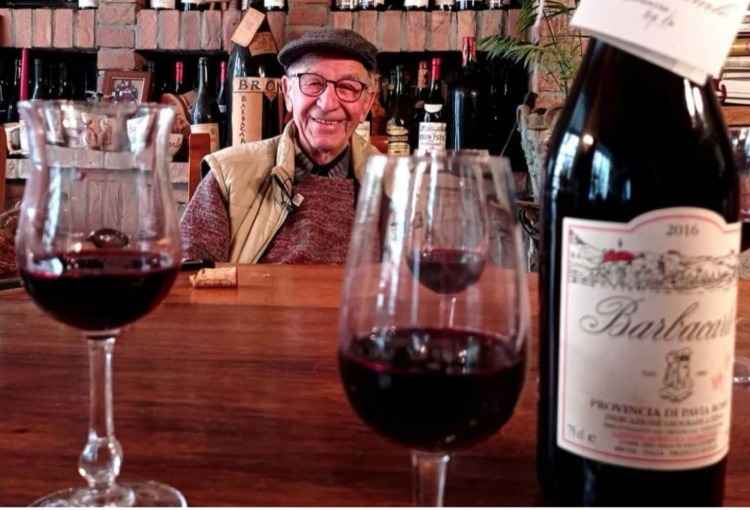
And in wine, the story is often the same. There are wines that never make it beyond Italy’s borders, yet within the country they are spoken of in hushed reverence, known only to those who live and breathe Italian culture at its deepest. The most legendary of these treasures is Lino Maga’s Barbacarlo (and its rare sibling, Montebuono), two monopole crus from a single hillside in Oltrepò Pavese each producing a mere few thousand bottles per vintage – barely enough to keep their historical clientele content.
The Oltrepò Pavese is south of Milan and east of Piacenza, where rolling hills and rocky soils produce some of Italy’s most characterful wines. Here, the Maga family has cultivated vines for generations, but it was Lino Maga (1941–2016) who transformed the family vineyard into legend. A man of vision and uncompromising principles, Lino believed that wine should express the vineyard, the vintage, and the human touch — nothing more, nothing less. Lino inherited a single monopole cru, a small hillside vineyard in Montebuono, entirely his own. This is extraordinary in Italy, where most vineyards are fragmented into tiny plots shared among multiple owners. From this monopole, Lino produced two wines that would define his legacy: Barbacarlo and Montebuono.
Luigi Veronelli, Italy’s most revered wine critic, described Barbacarlo as “un vino che parla, che racconta la terra” — a wine that speaks, that tells the story of its land. He often visited the vineyard himself, praising the “spiritual honesty” of the wines and calling Lino “un vero custode del patrimonio enologico italiano” — a true custodian of Italy’s wine heritage. Jancis Robinson called it “one of the most unique and enigmatic wines of Northern Italy, utterly faithful to its terroir.” Even in challenging vintages, Jancis Robinson has observed that Barbacarlo retains its unmistakable identity, a testament to Lino’s extraordinary skill in reading both vineyard and vintage conditions.
Whereas a Bartolo Mascarello can transport you straight to the heart of Barolo, and a Soldera can lift you to an imagined place high above Montalcino, the wines of Lino Maga take you on a spaceship to another galaxy, before crash-landing into a precise, unforgettable corner of Italy — a place you know by the scents, the character, the joy of terroir at its absolute finest. It’s that rare, euphoric feeling when Italy does what it does best, and you are reminded, blissfully, how wonderful it is to be alive.
These wines are so singular and magnificent that the only way to describe them is to imagine the love child of Gravner’s Ribolla, united with Valentini’s Montepulciano, marrying the offspring of Radikon’s Merlot and Quintarelli’s Alzero— a union of Italy’s greatest terroirs, techniques, and souls. Yet to the commercial, cookie-cutter score-chasing drinker, they are true misfits, best left for others to unravel. Their loss, our gain. These wines are ceremonial and should be honored as the centerpiece of an evening, though they work wonders finishing the night after a lineup of the finest bottles the world has to offer, culminating in one final pour that will leave companions breathless, whispering the question every great wine inspires: what is wine? 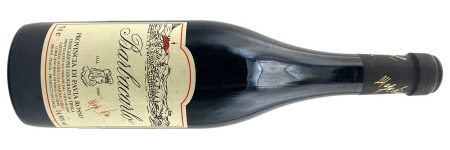
Barbacarlo is the flagship, a field blend of Croatina (50%), Uva Rara (30%), Ughetta (20%), and a touch of Vespolina — varietals often blended with Nebbiolo in the Gattinara or Lessona wines of Northern Piemonte — all from centenarian vines. Lino harvested by hand, meticulously sorted in small boxes, and fermented using natural indigenous yeasts, often whole-cluster, as he believed stems added aromatic lift, structure, and complexity. The wine was gently extracted through pigeage and remontage, never overworked, then aged in large neutral barrels — old Slavonian oak — for roughly 18–24 months, avoiding any new oak influence. In a technique reminiscent of Valentini’s Montepulciano, Barbacarlo was often bottled before complete fermentation had finished, leaving a hint of residual sugar and a subtle effervescence that adds lift, vibrancy, and an additional layer of tension to the wine. The result is rustic yet noble: earthy, aromatic, spicy, mineral-driven, and capable of aging gracefully for decades.
2016 Barbacarlo The 2016 vintage is immediately captivating, with a deep ruby core and garnet reflections. Aromas of black cherry, wild berries, cracked pepper, dried herbs, and a hint of mineral smoke rise from the glass. On the palate, it is balanced, energetic, and precise, with supple tannins framing layers of dark fruit, spice, and earthy nuances. The slight residual fermentation imparts a lively lift, enhancing freshness and vibrancy, while the mineral-driven finish is persistent and haunting. This is a wine of both immediacy and incredible aging potential, already expressive but designed to evolve gracefully over decades, revealing ever more complexity and depth with time.
Special Price $139.99 – 36 btls available
2018 Barbacarlo The 2018 vintage opens with a deep ruby color, tinged with youthful garnet at the rim. The nose is expressive and nuanced, revealing wild red and black cherries, ripe cranberry, dried herbs, black pepper, and a delicate hint of forest floor and mineral graphite. On the palate, the wine is vibrant and energetic, showing bright, precise acidity that balances the mid-palate richness. The tannins are fine-grained but persistent, giving structure without weight, and the slight residual fermentation adds a lifted, almost electrifying freshness. Flavors of dark fruit, spice, and crushed stone interweave with subtle floral and herbal notes, creating a multi-layered profile. The finish is long, mineral-driven, and hauntingly persistent, demonstrating the wine’s ability to evolve gracefully over decades.
Special Price $139.99 – 36 btls available
Wines are in the US and ready for delivery late September 
Montebuono 2016
Special Price $139.99 – 9 btls available
Montebuono 2018
Special Price $139.99 – 9 btls available
Montebuono 2020
Special Price $139.99 – 36 btls available
Wines are in the US and ready for delivery late September |
 |
 |
|
|
|
||||||||||||
|
|
|
|
||||||||||||
|
|
|
|
||||||||||||
|
|
|
|
||||||||||||
|
|
|
|
||||||||||||
| Monday-Tuesday |
| Closed |
| Wednesday-Friday |
| 12:00 pm - 7:00 pm |
| Saturday - Sunday |
| 12:00 pm - 5:30 pm |
| Copyright © 2026 All rights reserved | 


| Website Powered by WineFetch |